
How SAP in Manufacturing Is Reshaping Shop-Floor Efficiency
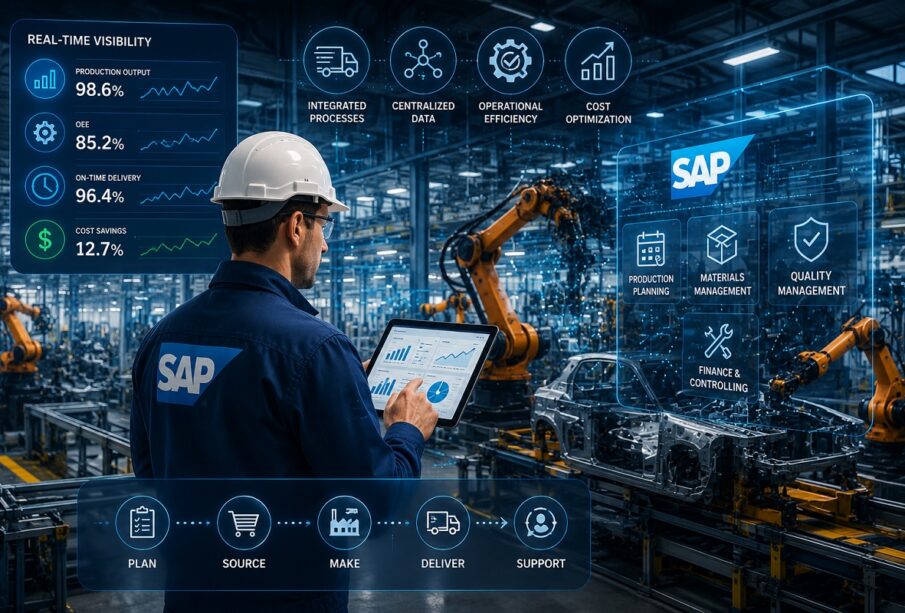
Manufacturing has always been a game of margins, timing, and precision. A single delayed shipment, an unnoticed machine breakdown, or a stockout on a critical raw material can ripple through an entire production schedule and hit the bottom line hard. As plants grow more complex – spanning multiple locations, product lines, and supplier networks — manual tracking and disconnected spreadsheets simply can’t keep pace. This is exactly the gap that SAP in manufacturing is built to close, giving plant leaders one connected, real-time view of everything happening on their shop floor.
What SAP in Manufacturing Actually Solves
At a practical level, SAP in manufacturing brings production planning, inventory management, quality control, and maintenance scheduling into a single integrated platform. Instead of a production planner checking one system for machine availability, another for raw material stock, and a third for open sales orders, everything lives in one place. That means fewer surprises, faster decision-making, and a lot less firefighting.
Consider a plant manager trying to fulfill a large order with a tight deadline. Without integrated ERP, they might discover a raw material shortage only after the production run has already started. With SAP in manufacturing, that shortfall shows up during planning — days or weeks in advance — giving the team time to reorder, adjust the schedule, or source an alternative supplier. The value isn’t just in the software; it’s in the time and money saved by catching problems before they become costly disruptions.
Quality management is another area where this integration pays off. Every manufacturer knows those in industries like automotive, pharmaceuticals, or industrial equipment lives and dies by traceability. SAP’s quality modules let teams track inspection results, non-conformances, and batch records directly against production orders, so if a defect surfaces, it’s possible to trace it back to the exact batch, machine, and shift — rather than guessing.
Why Industry-Specific Implementation Matters
Not all manufacturing is the same. A discrete manufacturer assembling machinery works very differently from a process manufacturer running continuous batches of chemicals or food products. Generic ERP configurations rarely fit either well, which is why implementation expertise matters just as much as the SAP license itself.
This is where a partner like Highbar Technocrat brings real value. Rather than deploying a cookie-cutter setup, experienced implementation teams configure SAP around how a specific plant actually operates — accounting for batch sizes, compliance requirements, equipment maintenance cycles, and even regional regulatory needs. Highbar Technocrat’s dedicated work in SAP for manufacturing reflects this kind of tailored approach, helping manufacturers move past generic templates toward a system that mirrors their real production environment.
Connecting the Shop Floor to the Business
One of the most underrated benefits of SAP in manufacturing is how it bridges the gap between shop-floor operations and business decision-making. Production data doesn’t just stay with the plant supervisor — it flows upward into finance, procurement, and sales, giving leadership a live picture of costs, capacity, and delivery timelines.
This connectivity becomes especially powerful during demand fluctuations. If a sudden spike in orders hits, sales teams can immediately see whether current production capacity can absorb it, rather than making promises the plant can’t keep. Similarly, when raw material costs shift, finance teams get visibility into margin impact almost instantly, instead of waiting for a month-end report.
Maintenance planning benefits too. Predictive and preventive maintenance scheduling within SAP helps manufacturers move away from reactive repairs — where a machine breaks down and production halts — toward planned downtime that doesn’t disrupt delivery schedules. Over time, this shift alone can meaningfully reduce unplanned outages and extend equipment life.
The Long-Term Payoff
Manufacturers who invest properly in SAP don’t just gain efficiency on day one — they build a foundation that scales as the business grows. Adding a new product line, opening a second plant, or expanding into new markets becomes far less chaotic when the underlying systems are already built to handle complexity. Reporting becomes more accurate, audits become less painful, and leadership spends less time reconciling numbers and more time making strategic calls.
That said, none of this happens automatically just by purchasing software. The real differentiator is implementation quality — how well the system is configured to match actual plant workflows, how thoroughly teams are trained, and how responsive support is once the system goes live. This is why manufacturers increasingly look for partners with deep domain knowledge, not just technical SAP certification.
Final Thoughts
SAP in manufacturing isn’t just an IT upgrade — it’s a shift in how a plant thinks about production, inventory, quality, and maintenance as one connected system rather than isolated functions. For manufacturers looking to modernize without losing the nuances that make their operation unique, working with a partner who understands both SAP and the manufacturing floor itself makes all the difference. Highbar Technocrat’s focus on tailored, industry-aware SAP implementations positions manufacturers to move from reactive firefighting toward proactive, data-driven production management — one connected system at a time.